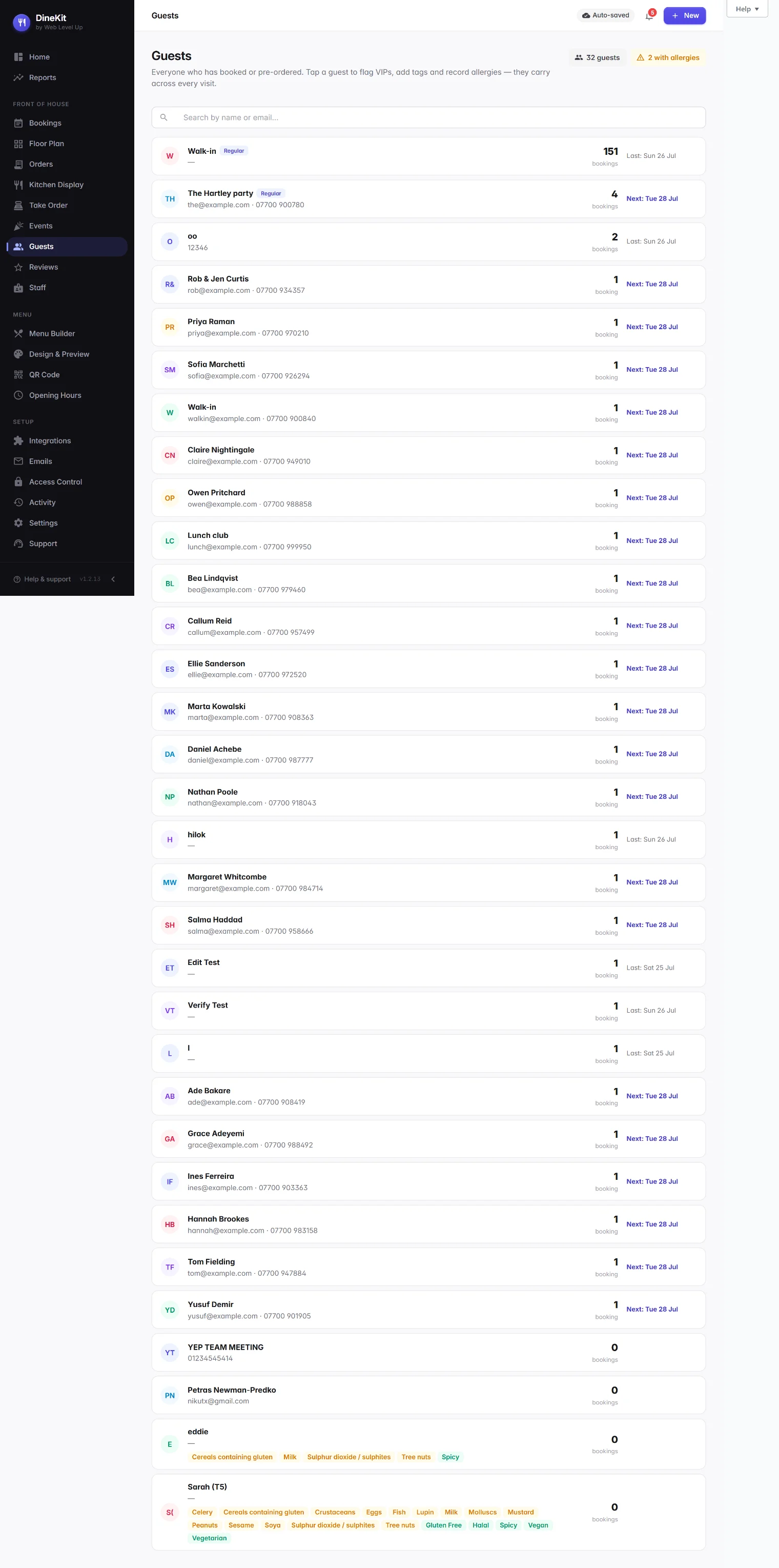
DineKit turns every booking, pre-order and takeaway into a real guest record — repeat-visit counts, a Regular badge, allergies remembered, and win-back emails to bring lapsed diners home. It all lives on your WordPress site, so you own the customer list, not a booking platform.
Here is the quiet problem in most independent restaurants: the people who love you most are invisible. The couple who come in every other Friday, the table that always asks for the gluten-free menu, the regular who hasn’t been seen in three months — none of that is written down anywhere you can use it. It lives in a waiter’s memory, on a scrap of paper by the pass, or in the head of the owner who happened to take the call.
So the same things go wrong on repeat. A guest tells you about a serious nut allergy on one visit and has to explain it all over again on the next, because nobody recorded it against them. A regular who came in fortnightly for a year simply stops, and you never notice the gap or reach out — they just quietly drift to the new place down the road. And when you finally want to fill a slow Tuesday, you realise you have no way to contact the very people who already know and like your food.
The deeper issue is ownership. If your bookings run through a reservations platform and your delivery through an aggregator, those companies hold your guest list. They can email your customers. You often cannot. You did the hard work of earning the relationship, and somebody else is renting it back to you — while charging commission on top. A restaurant customer database should belong to the restaurant.
DineKit is a free, open-source WordPress plugin. When it handles your table bookings, event pre-orders and online orders, it is also quietly building a guest CRM out of that activity — no data entry, no import, no separate subscription. Every diner who books a table or places an order becomes a profile, and DineKit keeps the useful facts attached to them.
It counts how many times each guest has been in and awards a Regular badge once they cross the threshold, so your team can spot a valued face at a glance. When a guest flags an allergy while pre-ordering for an event, DineKit merges that allergen straight onto their profile, so it is remembered the next time — you are not relying on someone happening to recall it. Each profile opens in a drawer where you can mark a guest as VIP, add tags, record allergies and notes, and see their history, then close it and get back to service.
On top of the database sits a retention layer. DineKit can send a post-visit review-request email, raise a manager alert when private feedback comes back low so someone can make it right quickly, and run an hourly wp-cron auto-send so the follow-up happens without anyone remembering to do it. For diners who have lapsed, it can include a win-back offer in the email to gently pull them back through the door. To be straight with you: the full unique-code voucher and redemption system is still on the roadmap and not shipped yet — today’s win-back is the offer message and rebook link, not a locked-down code engine.
Real capabilities, all first-party, all running inside your WordPress install.
Every booking and order rolls up into a per-guest visit count, so you can see who comes back and how often — the raw material of loyalty, tracked for you.
Once a guest crosses the repeat threshold they earn a Regular badge, giving front-of-house an instant cue to treat them like the returning friend they are.
Allergens a guest flags during event pre-orders are merged onto their profile, so a life-affecting detail is never forgotten between visits.
Open any guest in a drawer to set VIP status, add tags, record notes and adjust allergies — a tidy, editable record instead of scattered memory.
Send a post-visit request that asks for private feedback and links to your public review page for everyone alike — a compliant flow, not review gating.
When a guest leaves a low private rating, DineKit alerts a manager so you can acknowledge, apologise and put it right before it hardens into a bad review.
An hourly wp-cron job quietly sends the follow-ups to recent diners on a soft opt-in, capped and suppression-aware, so retention runs without a to-do list.
Include a return offer and a commission-free rebook link in the email to nudge guests who have drifted away back to your table.
Guest-management and CRM SaaS can do a lot — but you rent it monthly and, crucially, the guest list lives on their servers. Here is the honest comparison.
| What you need | DineKit | Paid CRM / marketing SaaS |
|---|---|---|
| Monthly fee | Free and open-source, forever | Ongoing subscription, often per-cover or tiered |
| Who owns the guest data | You — it lives in your own WordPress database | The vendor holds it on their platform |
| Built from your own bookings and orders | Yes — profiles form automatically from real activity | Often needs imports or their booking channel |
| Allergies remembered per guest | Yes — merged from pre-orders onto the profile | Varies; frequently a manual note field |
| Review requests | Built in, with a compliant same-link-for-all flow | Usually an add-on or higher tier |
| Win-back for lapsed diners | Offer and rebook link in the email (voucher engine on the roadmap) | Add-on module, extra cost |
| Lock-in | None — your data and site are yours to take anywhere | Leaving usually means losing the list |
It is easy to treat data ownership as a technicality until the day it matters. Then it matters enormously. A restaurant customer database is one of the few genuine assets a venue builds over years of service — and if it is trapped inside a third party’s platform, it is an asset you can lose overnight when prices rise, terms change, or the platform decides your guests are theirs to market to.
Because DineKit stores everything in your own WordPress site — the same site your customers already visit to see the menu and book a table — the guest list is unambiguously yours. You can export it, back it up, and email your own diners on your own terms. There is no phone-home, no external service holding the records hostage, and no per-cover fee that grows as your restaurant does. When a guest gives you their details at the point of a real booking or order, that relationship stays between you and them.
That ownership also makes the retention features honest. A win-back email from DineKit goes out under your name, from your address, with an unsubscribe link and a real return offer — direct marketing done properly under UK PECR rules, on a soft opt-in you can defend. You are not borrowing access to your own customers. You already have it.
The guest CRM is not a bolt-on — it is fed by the rest of the platform, which is exactly why it fills up on its own. Turn on table booking and every reservation creates or updates a guest record with their visit history. Run an evening through events and pre-orders and each diner’s dish choices and allergen flags flow straight onto their profile — that is where the “allergies remembered” magic actually comes from. Add online ordering and takeaway customers join the same database, so your regulars are counted whether they dine in, book ahead for a party, or order to the sofa.
Because it is all one plugin, there is nothing to sync and no integration to break. Every part of the operation quietly deposits into the same guest ledger, and the retention engine draws from it. The restaurant that uses DineKit end-to-end doesn’t just get a database — it gets one that keeps itself current, at no cost, on infrastructure it already owns.
The guest CRM fills itself the more of DineKit you run: turn on table booking to log every reservation against a diner, use events and pre-orders to capture dish choices and allergies automatically, and add online ordering so takeaway customers join the same database — all owned by you, on your own site.
DineKit is free, self-contained and live in minutes. Own your menus, your bookings and your data.
Get DineKit — FreeWe use essential cookies to run this site and, with your consent, Google Analytics to see how it's used. See our Cookie Policy.